Page Navigation
Site Navigation
The Trades of Edinburgh
Edinburgh Incorporations
The order of precedence among the incorporations is determined not by their relative antiquity but by the Act of Sett of the Burgh of Edinburgh, which was agreed by King James VI in a decreet arbitral in 1583. Part of the reason for this is that by that time several of the trades, most of which were a century or more old, no longer possessed their original seals of cause and did not know the year in which they had been founded.
The Trades of Edinburgh:
1. The Incorporation and Royal College of Surgeons
2. The Incorporation of Goldsmiths
3. The Incorporation of Skinners
4. The Incorporation of Furriers
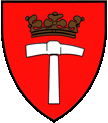
5. The Incorporation of Hammermen
6. The Incorporation of Wrights
7. The Incorporation of Masons
8. The Incorporation of Tailors
9. The Incorporation of Baxters
10. The Incorporation of Fleshers
11. The Incorporation of Cordiners
12. The Incorporation of Weavers
13. The Incorporation of Waulkers
14. The Incorporation of Bonnetmakers & Dyers
15. The Incorporation of Candlemakers
The Society of Barbers
With thanks to The Incorporated Trades of Edinburgh
The Blue Blanket
BLUE BLANKET - 1482
The Blue Blanket is the name of the Edinburgh Tradesmen’s Banner.
Its early history is bound up in so much mythology that it is
difficult to sift the actual facts from the fiction. Legend has it
that it was given to the tradesmen and craftsmen of Edinburgh by
James III in 1482, but there is no authentic document of the period
that records the supposed event. It is also said to have been
carried as the battle flag of the Edinburgh Trades at the Battle of
Flodden in 1513, when a large number of craftsmen died defending it
and their king. The tattered remains of the Banner are reputed to
have been brought back to Edinburgh the next day by Randolph Murray,
captain of the Guard, and handed over, with the dreadful tidings of
the defeat of the Scottish army and the death of the king.
The first definite reference to the Blue Blanket in a historical
document occurs in 1543, at the beginning of the reign of Mary,
Queen of Scots. In that year is was raised in the Council Chamber by
the Deacons of the Incorporated Trades, who were protesting against
encroachments on their privileges and deprivation of their ancient
rights.
James VI mentions it in his idiosyncratic book, The Basilikon Doron.
In the first edition, published in 1599, he wrote:
“And the Craftes-men thinke wee should bee content with their worke,
howe bad and deare so ever it bee; and (if they in anie thing bee
controlled) up must the blewe-blanket goe.”
Subsequent editions alter the wording to read:
“And the Craftes-men thinke we should be content with their worke,
howe bad and deare so ever it be: & if they in any thing be
controlled, up goeth the blew-blanket.”
Just as regimental colours are renewed from time to time when they
become worn and tattered, so the Blue Blanket has been renewed
several times.
The version that survives at the present time appears to date from
just after the restoration of Charles II to his throne in 1660,
probably sometime in 1661. It is in the form of a large
swallow-tailed gonfalon hanging vertically from a horizontal pole
and it is about ten feet high and more than six feet across. In its
top left canton it bears a saltire, between the arms of which are a
royal Crown and a Scottish Thistle. The main feature of the banner,
however is the inscription, which is contained in two ribbons and
which reads:
“FEAR ∙ GOD ∙ AND ∙ HONOR ∙ THE ∙ KING ∙ WITH ∙ A ∙ LONG/
LYFFE ∙ AND ∙ A ∙ PROSPEROUS REIGNE/
AND/ WE ∙ THAT ∙ IS ∙ TRADDS ∙ SHALL ∙ EVER ∙ PRAY ∙ TO ∙ BE ∙
FAITHFULL/
FOR ∙ THE ∙ DEFENCE ∙ OF HIS SACRED MAIESTIES ∙ ROYAL ∙ PERSONE ∙
TILL ∙ DEATH”
This saying has resonances with other Covenanting war-cries of the
post-Restoration period and it may not have appeared in the earlier
versions.
The Blue Blanket is too fragile to be removed from its case and it
is no longer blue; over the centuries it has faded to a non-descript
pale greyish brown.
In 2012 a new version was made for ceremonial use and it has
appeared in Edinburgh on several occasions. It is waved from the
platform of the Mercat Cross every year at the Riding of the Marches
and it is carried in solemn procession at the Kirking of the
Deacons. In 2014 it was carried from the Church of the Greyfriars at
the head of the procession which went to the spot where Mary Erskine
lies buried, for the Incorporated Trades to pay respect to her
memory as their principal benefactor.
Text from the Incorporated Trades website (June 2015) - Link here
The Hammermen Today
Today the role of the Hammermen is totally different from that of the members of five hundred years ago.
The desire to promote craft skills is of paramount concern and contacts with Heriot Watt University Faculty of Engineering and The Telford College, both in Edinburgh are maintained. A charity fund, to which members contribute through their annual subscription enable the Hammermen to fund an annual award to the best student in the Faculty of Engineering – at Heriot Watt University. The recipients, who present a brief report on their work at the Annual Dinner – tend to have undertaken very worthy projects, and this has often been very valuable in terms of future career prospects. ..... continues in the archive.